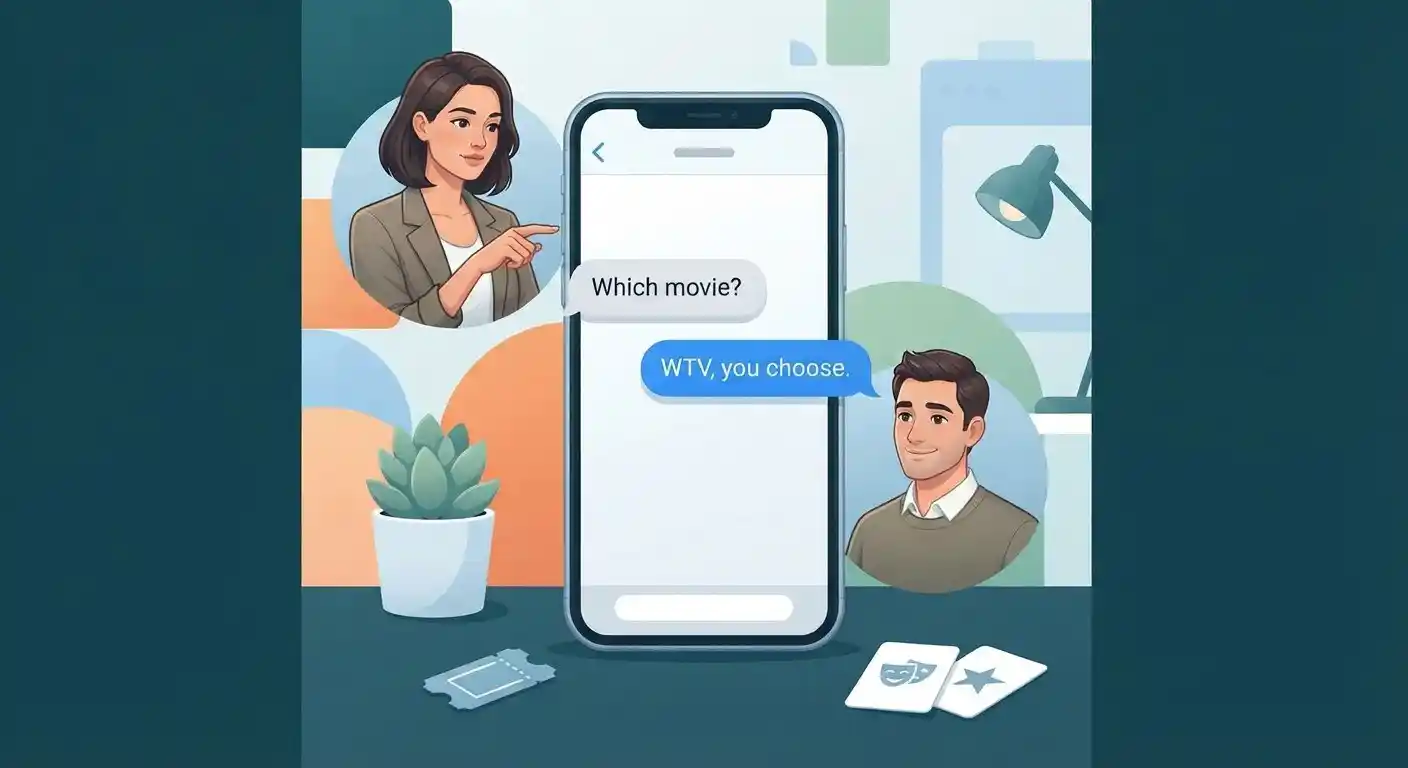
WTV in text usually means “whatever.” It is a casual texting abbreviation used to show that someone has no strong preference, does not mind, or wants to move on from a topic. The exact tone depends on context.
Key Takeaways
- WTV stands for “whatever.”
- It is an informal texting abbreviation and internet slang term.
- WTV can express flexibility, indifference, or dismissal.
- A friendly “wtv, you choose” can mean “I’m fine with whatever you choose.”
- A short “wtv.” during an argument can sound annoyed or dismissive.
- WTV is generally better for casual conversations than formal or professional writing.
WTV Meaning in Text
The main WTV meaning in text is “whatever.” It is a shortened form of the word whatever, commonly used in casual messages and online conversations. (techfynix.com)
People use WTV when they do not have a strong preference, do not want to spend more time discussing something, or simply want to accept any available option.
For example:
“WTV, you pick the movie.”
This means:
“Whatever, you pick the movie.”
The meaning is simple, but the tone can change. WTV may sound relaxed in one conversation and dismissive in another. Context, punctuation, emojis, and the relationship between the people can all affect how it comes across. (linezforlife.com)
What Does WTV Stand For?
WTV stands for “whatever.”
It is a texting abbreviation rather than a traditional acronym with a separate phrase behind each letter. You may see it written as “wtv,” “WTV,” or “Wtv,” and the basic meaning remains the same. (Wiktionary)
Unlike some abbreviations that have several unrelated meanings, the dominant meaning of WTV in casual text is “whatever.”
How Is WTV Used?

In Text Messages
WTV is often used when someone does not care which option is chosen.
For example:
“Pizza or burgers?”
“Wtv, I’m good with either.”
Here, WTV is flexible rather than rude.
In DMs
Someone might use WTV when they want to keep a conversation short.
“Are you coming with us?”
“Wtv, I’ll decide later.”
The meaning can depend on whether the person is simply undecided or trying to end the discussion.
In Group Chats
WTV can be useful when someone has no preference.
“Friday or Saturday?”
“wtv works for me.”
This usually means that either option is acceptable.
On Social Media
WTV can appear in comments, replies, captions, and casual messages. It generally carries the same basic meaning of “whatever.”
During an Argument
This is where WTV can sound more dismissive.
“Why are you still arguing about this?”
“WTV.”
In this situation, WTV may communicate something closer to “whatever, I’m done discussing this.”
WTV in Different Contexts
From a Friend
If a friend says:
“Wtv, you choose.”
they are probably saying they do not have a preference.
If they simply say:
“wtv.”
the message could be more dismissive, especially if you were already disagreeing.
From a Guy
If a guy texts “wtv,” the abbreviation itself does not have a special meaning because of his gender.
“Wtv, your choice” may simply mean he is letting you decide. “Wtv.” after an argument may sound more frustrated or dismissive.
The conversation matters more than whether the sender is a guy or a girl.
From a Girl
The same principle applies if a girl sends WTV. The abbreviation does not automatically indicate a particular emotion or intention.
Look at what was said before and after it.
From Someone You Like
If someone you like sends “wtv,” it does not automatically mean they are upset, losing interest, or trying to reject you.
For example:
“Where do you want to eat?”
“Wtv, you choose.”
This can simply mean they are happy for you to choose.
In Dating
WTV can appear in casual dating conversations just as it can in conversations between friends. Its meaning depends on the specific message.
A message such as “wtv works for me” sounds flexible, while a standalone “wtv.” can sound more detached.
In a Group Chat
In a group chat, WTV can simply mean that someone does not care which option the group chooses.
“Beach or movie?”
“WTV 😂”
The emoji can make the response feel more playful.
Real Chat Examples
- “Where should we eat?”
“Wtv, you choose.” - “Friday or Saturday?”
“Wtv works for me.” - “Do you want pizza or tacos?”
“Wtv, I’m hungry.” - “Which color should I get?”
“Wtv you like better.” - “Should we watch a comedy or action movie?”
“Wtv 😂” - “Are you coming tonight?”
“Wtv, I’ll see.” - “Why are we still talking about this?”
“Wtv.” - “You said you wanted to go.”
“Wtv, it’s fine.” - “Pick the restaurant.”
“Wtv is good.” - “Do you care which one we choose?”
“Nah, wtv.” - “Should I send it now or later?”
“Wtv works.” - “You never listen to me.”
“Wtv.” - “Want to play later?”
“Wtv, whenever.” - “Which one do you want?”
“Honestly, wtv.” - “Are you mad?”
“No, wtv.” - “Should we go Saturday?”
“Wtv, Saturday is fine.” - “You choose the movie.”
“Wtv 😂” - “Why did you change your mind?”
“Wtv, forget it.” - “Do you want to talk about it?”
“Wtv.” - “Coffee or tea?”
“Wtv, either is fine.”
How to Reply to WTV
The best response depends on the tone behind the message.
Casual Replies
If someone says:
“Wtv, you choose.”
You can reply:
- “Okay, I’ll pick.”
- “Sounds good.”
- “Cool, I’ll decide.”
- “Got it.”
Friendly Replies
If the conversation is relaxed:
- “Haha okay 😂”
- “Either works for me too.”
- “Deal.”
- “I’ll choose then.”
Funny Replies
If a friend sends a playful WTV:
- “That’s a very detailed answer 😂”
- “Wow, so helpful 😂”
- “Fine, I’m choosing then.”
Neutral Replies
If you cannot tell whether they are annoyed:
- “Are you okay?”
- “Do you mean you don’t mind?”
- “No worries, I just wanted your opinion.”
Flirty or Relationship Replies
WTV itself is not a romantic expression. If the conversation already has a playful tone, you can respond naturally:
- “Then I’m choosing for both of us 😂”
- “Okay, but don’t blame me for my choice.”
- “Fine, I’ll decide.”
There is no need to interpret WTV as flirting unless the rest of the conversation clearly supports that.
What Tone Does WTV Have?
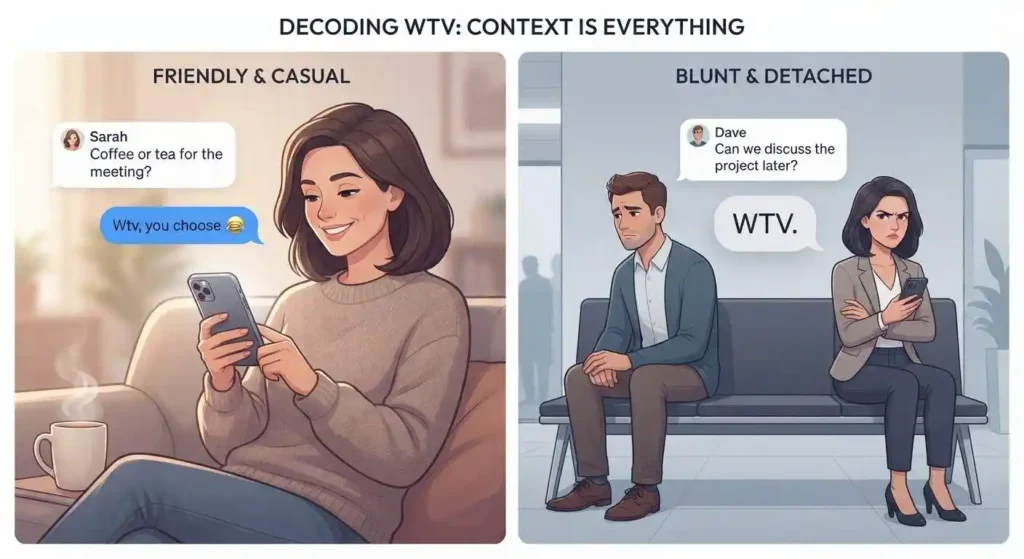
WTV is context-dependent. It can sound:
- Casual
- Relaxed
- Flexible
- Indifferent
- Playful
- Dismissive
- Slightly annoyed
For example:
“Wtv, you choose 😂”
usually sounds more relaxed.
But:
“WTV.”
especially after a disagreement, can feel much more blunt.
Punctuation can influence the tone, but it is not a guaranteed rule. The entire conversation matters. (slanginternet)
Is WTV Rude or Offensive?
WTV is not inherently rude or offensive.
However, a standalone WTV can sometimes sound dismissive because it may suggest that the person does not want to continue the conversation.
Compare:
“Wtv, either one works.”
with:
“Wtv.”
The first sounds more flexible. The second can feel colder depending on what happened before it.
WTV is appropriate for casual texts, DMs, and informal conversations. It is usually better to avoid it in professional emails, formal writing, or other situations where clear and polished language is expected.
Other Meanings of WTV
In ordinary texting and internet slang, “whatever” is the important meaning to know. WTV can have specialized meanings in particular fields, but those are not the main interpretation when someone sends WTV in a casual text.
If you see WTV in a technical, business, medical, or other specialized document, the surrounding subject should be used to determine whether it has a field-specific meaning.
Common Mistakes About WTV
Assuming WTV Always Means Someone Is Mad
It does not. WTV can simply mean that someone has no preference.
Assuming WTV Is Always Friendly
A standalone WTV can sound dismissive, particularly during an argument.
Assuming WTV Has a Special Meaning From a Guy or Girl
The sender’s gender does not change the basic meaning of WTV.
Assuming WTV Means “I Don’t Care” in Every Situation
“Whatever” can mean “I don’t mind,” “either option is fine,” or “I don’t want to discuss this anymore.” Context determines which interpretation fits.
Confusing WTV With Similar Abbreviations
WTV is closest to “whatever,” while abbreviations such as IDC and NVM communicate different ideas.
WTV and Related Slang
| Term | Meaning | Common Use |
|---|---|---|
| WTV | Whatever | Showing flexibility or indifference |
| IDC | I Don’t Care | Saying something does not matter to you |
| NVM | Never Mind | Taking back or dropping a previous thought |
| IDK | I Don’t Know | Saying you do not know |
| TBH | To Be Honest | Introducing an honest opinion |
| NGL | Not Gonna Lie | Introducing an honest statement |
| WHATEVS | Whatever | Playful or informal version of “whatever” |
People Also Ask About WTV Meaning in Text
What does WTV mean in a text message?
WTV means “whatever.” It is a shortened form used in casual texting and online conversations to express flexibility, indifference, or dismissal depending on context.
Is WTV the same as IDC?
Not exactly. WTV means “whatever,” while IDC means “I don’t care.” They can sometimes communicate a similar attitude, but they are not interchangeable in every sentence.
Does WTV always mean someone is annoyed?
No. WTV can simply mean that someone does not have a preference. A message such as “wtv, you choose” can be completely casual, while a standalone “wtv.” after an argument may sound annoyed or dismissive.
What does WTV mean from a guy?
WTV has the same basic meaning regardless of the sender’s gender. A guy using WTV may be saying “whatever,” but whether he sounds relaxed, uninterested, or annoyed depends on the conversation.
What does WTV mean from a girl?
The meaning does not change based on gender. A girl may use WTV to show that she has no preference, is being casual, or wants to end a discussion.
Is WTV rude in texting?
WTV is not automatically rude, but it can sound dismissive when used by itself. Adding context, such as “wtv works for me,” usually makes the intended meaning clearer.
Can WTV be flirty?
WTV is not normally a flirty abbreviation. If it appears in a playful or romantic conversation, the surrounding messages—not WTV itself—would determine whether the exchange has a flirty tone.
What is the difference between WTV and NVM?
WTV means “whatever,” while NVM means “never mind.” WTV usually expresses indifference or lack of preference, whereas NVM is commonly used to withdraw or drop something previously mentioned.
Conclusion
WTV meaning in text is usually “whatever.” It is an informal texting abbreviation that can express flexibility, indifference, or dismissal depending on the situation.
The tone is especially important. “Wtv, you choose” can sound relaxed, while a standalone “wtv” during an argument may feel cold or annoyed. WTV is suitable for casual communication but is generally not the best choice for formal or professional writing.
When interpreting WTV, focus on the full conversation rather than the abbreviation alone. That will help you tell whether the sender simply has no preference or is trying to end the discussion.

For three and a half years, Charlotte Reed has worked as a writer shaping puns and jokes around distinct subjects and vocabulary. She covers food, animals, seasonal themes, technology, entertainment, and trending topics. Her process includes examining topic-specific language, building wordplay from relevant terms, and editing punchlines for sharper phrasing, structure, and comedic timing.