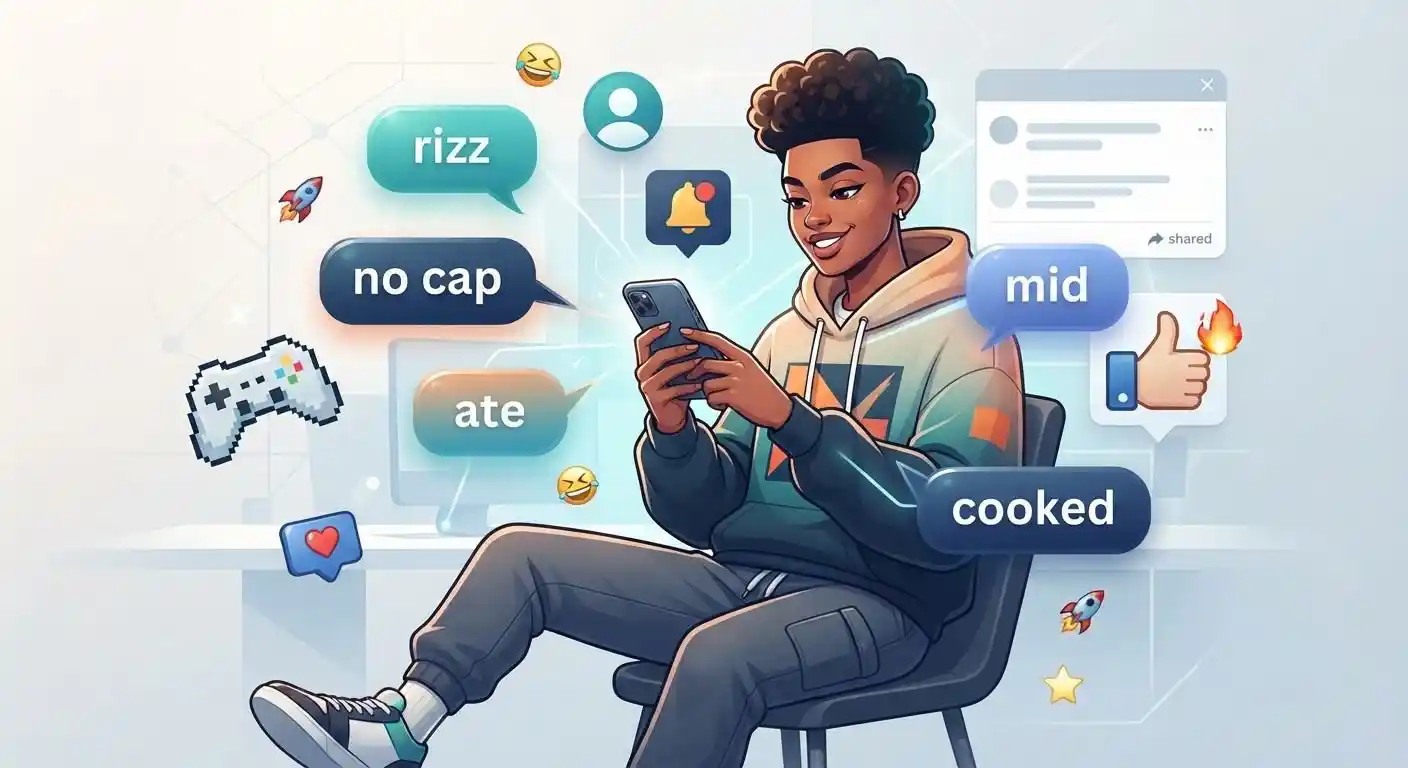
Gen Z slang refers to informal words, phrases, abbreviations, and expressions associated with Generation Z and modern online communication. It appears in texts, social media, memes, group chats, gaming communities, and everyday casual conversations.
Key Takeaways
- Gen Z slang is a broad category, not one specific language or acronym.
- Many terms are used online as well as in everyday speech.
- TikTok, Instagram, YouTube, Discord, gaming, memes, music, and earlier internet communities have all influenced the vocabulary associated with Gen Z.
- Some slang words existed before Gen Z but became widely associated with younger internet users.
- Context and tone are important because many terms can be ironic, playful, exaggerated, or different from their literal meanings.
- Gen Z slang is informal and usually does not belong in formal or professional writing.
Gen Z Slang Meaning in Text
Gen Z slang means the casual language, expressions, and shorthand commonly associated with Generation Z and contemporary internet culture.
It is not a traditional acronym, so there is no full form for “Gen Z slang.” Instead, the phrase describes a broad style of informal communication.
Examples include words and phrases such as:
- rizz
- no cap
- cap
- slay
- ate
- mid
- sus
- lowkey
- highkey
- delulu
- W
- L
- it’s giving
- locked in
- cooked
- situationship
Not every term was created by Gen Z. Some expressions have older histories or come from specific cultural and online communities before becoming more widely used. For example, sources discussing Gen Z slang note influences from Black English, LGBTQ+ communities, music, gaming, fandoms, and earlier internet culture.
What Does Gen Z Slang Stand For?
Gen Z slang does not stand for a specific phrase because it is a category of language rather than an abbreviation.
“Gen Z” is short for “Generation Z,” while “slang” refers to informal language used in particular social groups or communities.
Together, “Gen Z slang” simply means informal words and expressions associated with Generation Z and the online communities where these expressions circulate.
It is also important not to treat the label as a strict dictionary category. A word can be associated with Gen Z without having originated with Gen Z, and people outside that generation may also use or understand it.
How Is Gen Z Slang Used?
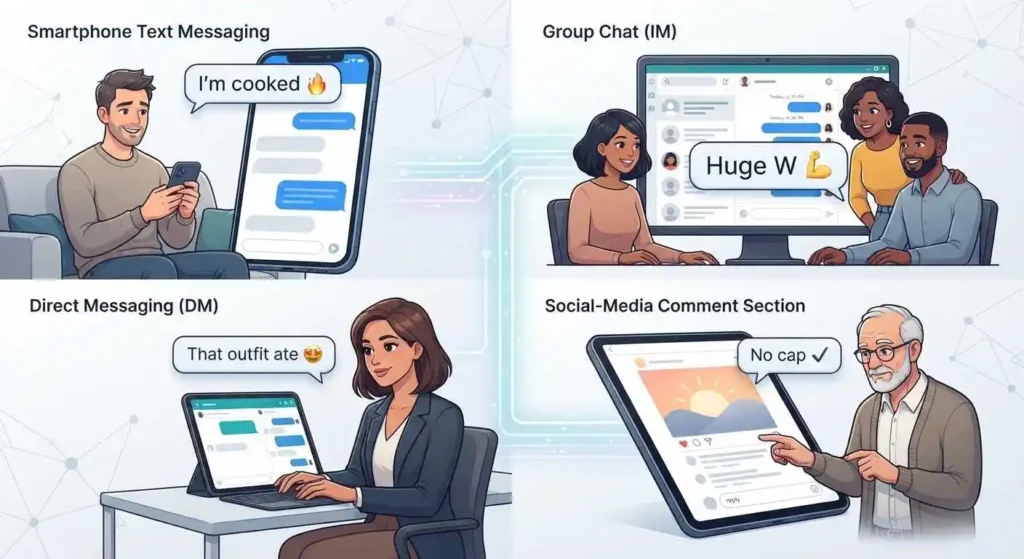
Gen Z slang can appear in many types of informal communication.
Text Messages
People may use slang to make a message shorter, funnier, or more expressive.
For example:
“That test was brutal 😭”
“Honestly, I’m cooked.”
DMs
Slang is common in casual direct messages, especially when people already know each other.
For example:
“Your outfit ate.”
“Stop, you’re making me delulu 😂”
Group Chats
Group chats often use slang, memes, abbreviations, and exaggerated expressions.
For example:
“That is an L.”
“No cap, that was hilarious.”
Social Media
Gen Z-associated slang frequently appears in captions, comments, videos, and memes.
For example:
“Main character energy.”
“It’s giving summer.”
“That outfit ate.”
Gaming
Some slang overlaps with gaming communities and online culture.
Terms such as “W,” “L,” “NPC,” “cooked,” and “locked in” can appear in gaming-related conversations as well as general social-media language.
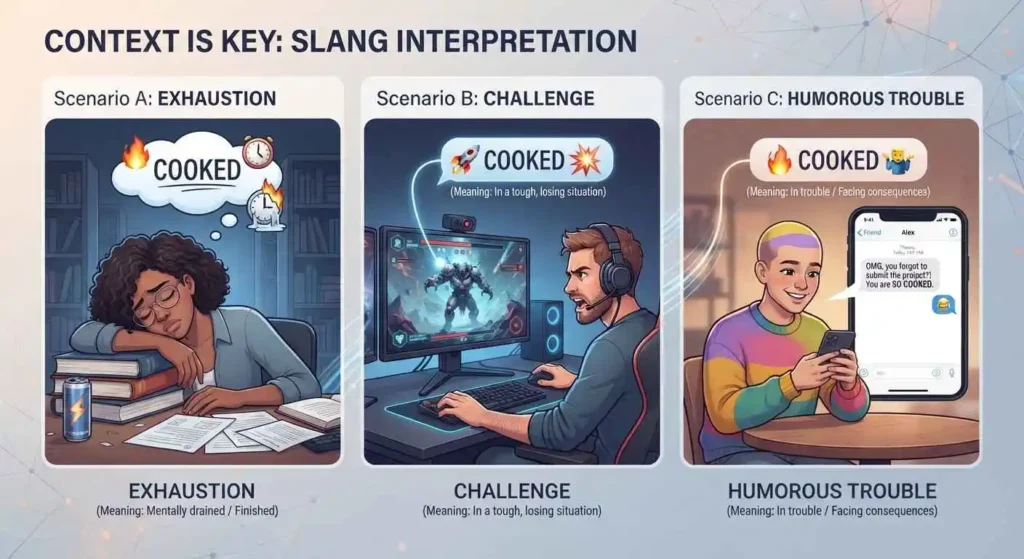
Gen Z Slang in Different Contexts
The meaning of slang is often easier to understand when you consider the situation.
From a Friend
If a friend says:
“You ate that presentation.”
they are probably complimenting how well you did.
If they say:
“You’re cooked.”
they may be joking that you are in trouble or have little chance of succeeding, depending on the situation.
From Someone You Don’t Know
A stranger using slang may simply be trying to sound casual or friendly. The specific word and conversation matter more than the fact that they use Gen Z slang.
From Someone You Like
Terms such as “rizz,” “pookie,” or “delulu” can appear in playful conversations involving people who like each other.
However, slang alone does not prove that someone is flirting or romantically interested. Look at the complete conversation and the person’s behavior rather than assigning romantic meaning to one word.
In Dating Conversations
Some Gen Z slang is especially common in conversations about relationships.
For example:
- “situationship” describes a relationship that does not have a clearly defined label.
- “rizz” refers to charm or the ability to attract someone.
- “the ick” refers to a sudden feeling of aversion toward someone, often in a dating context.
- “delulu” can describe unrealistic or overly hopeful thinking, sometimes about a romantic interest.
In a Group Chat
A term can become more playful when several friends already understand the joke or reference.
For example:
“Bro is cooked 💀”
may be a humorous way of saying someone is in a difficult situation.
In Social Media Comments
Slang can be used to react quickly to photos, videos, opinions, and memes.
Examples include:
“Ate.”
“W.”
“Mid.”
“It’s giving.”
The exact meaning depends on what is being discussed.
Real Chat Examples
- “That outfit ate.”
- “No cap, this is the best pizza.”
- “Bro is cooked 😂”
- “That was a huge W.”
- “That movie was kinda mid.”
- “I’m lowkey excited.”
- “I’m highkey tired.”
- “She has so much rizz.”
- “That explanation was actually fire.”
- “This whole situation is giving chaos.”
- “I’m locked in today.”
- “Don’t be delulu.”
- “That was an L.”
- “He’s acting like an NPC.”
- “This song is bussin.”
- “That’s sus.”
- “I fear you ate.”
- “The new haircut is giving.”
- “I’m in my study era.”
- “That comeback was actually wild.”
- “No cap, I forgot.”
- “You really thought that would work? 😭”
- “That was a W for sure.”
- “I’m cooked after that exam.”
- “The vibes are immaculate.”
These examples show why Gen Z slang cannot always be translated word-for-word. The intended meaning often depends on tone, context, humor, and the relationship between the speakers.
How to Reply to Gen Z Slang
There is no single response to Gen Z slang because the appropriate reply depends on the specific expression.
Casual Replies
If someone says:
“That outfit ate.”
You could reply:
- “Thanks!”
- “Glad you like it.”
- “I was hoping it worked 😂”
If someone says:
“No cap.”
You might say:
- “For real.”
- “Exactly.”
- “Same.”
Friendly Replies
If someone says:
“That was a W.”
You could answer:
- “Huge W.”
- “Definitely.”
- “We did it 😂”
Funny Replies
If a friend says:
“You’re cooked.”
You could reply:
- “It’s over for me 😂”
- “Absolutely finished.”
- “Let me pretend I have a plan.”
Neutral Replies
If you do not understand a slang term, asking is completely fine:
- “What does that mean?”
- “Wait, what does ‘cooked’ mean here?”
- “Can you translate that into normal English? 😂”
Flirty or Relationship Replies
If slang is being used in a playful romantic conversation, you can match the existing tone.
For example:
“You’ve got rizz.”
Possible replies:
- “You noticed? 😂”
- “Maybe a little.”
- “Coming from you, I’ll take that.”
The slang itself does not establish whether the conversation is romantic.
What Tone Does Gen Z Slang Have?
Gen Z slang is usually:
- Casual
- Informal
- Conversational
- Playful
- Expressive
- Humorous
- Context-dependent
Some expressions can also be sarcastic or deliberately exaggerated.
For example, saying “I’m cooked” may not literally mean someone is physically cooked. It can humorously communicate that someone is exhausted, overwhelmed, or in a difficult situation.
Similarly, “ate” is usually not about eating food when used as a compliment. It can mean someone performed very well or looked especially good.
This is why understanding the tone is often just as important as knowing the dictionary definition.
Is Gen Z Slang Rude or Offensive?
Gen Z slang is not automatically rude or offensive. Most terms are simply informal expressions.
However, appropriateness depends on the specific word and setting.
Casual Conversations
Gen Z slang can fit naturally among friends and in informal conversations.
Social Media
Slang is commonly used in casual posts, comments, captions, and DMs.
School
Informal slang may be fine in casual communication with friends, but it generally should not replace appropriate language in assignments or formal school work.
Work
Some slang may appear in casual workplace conversations, but professional communication usually calls for clearer and more neutral language.
Formal Writing
Gen Z slang is generally not appropriate for formal essays, reports, applications, or other professional writing unless the subject itself is slang or online culture.
Other Meanings of Gen Z Slang
Gen Z slang does not have a separate technical, financial, medical, or business meaning. It is primarily a linguistic and cultural term.
However, individual slang expressions can have different meanings in specialized communities.
Gen Z Slang in Gaming
Gaming culture overlaps with modern internet slang. Words such as “W,” “L,” “NPC,” “cooked,” and “locked in” can appear in gaming conversations.
Gen Z Slang in Dating
Dating has its own set of commonly discussed expressions, including “situationship,” “rizz,” “the ick,” and “talking stage.”
Gen Z Slang on Social Media
Social platforms have helped many expressions spread quickly between communities. TikTok, Instagram, YouTube, Discord, and other online spaces can all expose people to slang, although no single platform owns Gen Z slang.
Common Mistakes About Gen Z Slang
Assuming Gen Z Invented Every Term
Not every word labeled “Gen Z slang” originated with Gen Z. Some expressions have much older histories or come from specific cultural communities.
Thinking Slang Has One Permanent Meaning
Meanings can shift over time and across communities. A word may also have both a literal meaning and a slang meaning.
Taking Every Expression Literally
“Cooked,” “ate,” “fire,” and “dead” can all have meanings that differ from their literal dictionary definitions when used as slang.
Assuming Slang Shows Someone’s Personality
Using one slang word does not tell you everything about a person’s age, personality, background, or interests.
Assuming Slang Always Means the Same Thing Online
Context matters. A word used in a gaming chat may carry a slightly different meaning from the same word in a dating conversation or social-media comment.
Trying to Use Every New Slang Word
You do not need to use slang simply because it is popular. Understanding a term is different from forcing it into conversation.
Gen Z Slang and Related Slang
| Term | Meaning | Common Use |
|---|---|---|
| Rizz | Charm or ability to attract someone | Dating and casual conversation |
| No cap | Seriously; no lie | Emphasizing honesty |
| Cap | A lie or exaggeration | Calling something untrue |
| Ate | Did something very well | Praise or approval |
| Slay | Did very well or looked great | Praise |
| Mid | Average or disappointing | Reviews and opinions |
| W | Win or something positive | Approval |
| L | Loss or something negative | Disapproval |
| Sus | Suspicious | Calling something questionable |
| Lowkey | To some degree or quietly | Softening or qualifying a statement |
| Highkey | Openly or strongly | Emphasizing a statement |
| Delulu | Delusional; unrealistically hopeful | Jokes and casual conversation |
| Cooked | In trouble, exhausted, or unlikely to succeed | Situations and reactions |
| Locked in | Highly focused or committed | Work, school, gaming, or goals |
| Situationship | An undefined romantic connection | Dating |
These terms are related to the broader category of internet and youth slang, but they do not all have the same origin or usage history. Some have older roots that predate their current association with Gen Z.
People Also Ask About Gen Z Slang
What is Gen Z slang in simple terms?
Gen Z slang is informal language associated with Generation Z and modern online culture. It includes words, phrases, abbreviations, and expressions used to communicate humor, emotion, approval, disagreement, or social meaning quickly.
What are examples of Gen Z slang?
Examples include rizz, no cap, cap, slay, ate, mid, W, L, sus, lowkey, highkey, delulu, cooked, and locked in. The meanings and popularity of individual terms can change over time.
Why does Gen Z use so much slang?
Slang gives people short and expressive ways to communicate ideas, reactions, humor, and group identity. Online communities can also spread new expressions very quickly, which helps certain terms move from niche communities into wider everyday use.
Is Gen Z slang only used by Gen Z?
No. People from other generations can understand or use Gen Z-associated slang. A term may become strongly associated with Gen Z without being exclusive to that generation.
Where does Gen Z slang come from?
There is no single source. Modern slang can draw from social media, gaming, music, memes, fandoms, earlier internet language, and established cultural varieties of English. Some expressions commonly labeled Gen Z slang have roots that predate Gen Z.
Is Gen Z slang the same as internet slang?
There is significant overlap, but the terms are not identical. Internet slang is the broader category, while Gen Z slang refers to expressions particularly associated with Gen Z and the online communities connected with that generation.
Does Gen Z slang change quickly?
Yes, individual expressions can rise, spread, change meaning, or fade from common use. Current slang guides emphasize that the vocabulary is constantly changing rather than being a fixed dictionary.
Should you use Gen Z slang in formal writing?
Usually not. Gen Z slang is primarily informal, so standard English is generally a better choice for school assignments, professional communication, applications, and formal writing.
Conclusion
Gen Z slang is a broad collection of informal words, phrases, abbreviations, and expressions associated with Generation Z and modern online communication. It is not a single language or acronym, and its vocabulary changes over time.
Terms such as rizz, no cap, slay, ate, mid, W, L, sus, delulu, and cooked can communicate approval, humor, criticism, emotion, or other ideas in a short and expressive way.
The most important thing to remember is that context matters. Some terms have older cultural or internet origins, meanings can change, and slang does not have to be used simply because it is associated with Gen Z. Understanding the meaning and tone is often more useful than trying to imitate the language.

For three and a half years, Charlotte Reed has worked as a writer shaping puns and jokes around distinct subjects and vocabulary. She covers food, animals, seasonal themes, technology, entertainment, and trending topics. Her process includes examining topic-specific language, building wordplay from relevant terms, and editing punchlines for sharper phrasing, structure, and comedic timing.