
Social media slang refers to informal words, phrases, abbreviations, acronyms, and expressions used in online communication, especially in posts, comments, DMs, chats, and social media conversations.
Key Takeaways
- Social media slang is informal language used in online communication.
- It can include abbreviations, acronyms, shortened words, phrases, and expressions.
- Meanings can depend on context, platform, conversation, and audience.
- Common examples include LOL, FOMO, GOAT, POV, TBH, SMH, and “no cap.”
- Social media slang is generally more appropriate for casual communication than formal writing.
- A slang term does not always have one fixed meaning across every context.
Social Media Slang Meaning in Text
In text, social media slang means informal language used to communicate quickly, casually, or expressively online. It includes text slang, internet slang, texting abbreviations, messaging shorthand, acronyms, and informal phrases.
Some examples are:
- LOL — laughing out loud
- TBH — to be honest
- FOMO — fear of missing out
- GOAT — greatest of all time
- SMH — shaking my head
- POV — point of view
- IYKYK — if you know, you know
- No cap — no lie or honestly
Social media slang can appear in posts, captions, comments, DMs, group chats, and other forms of online communication. The meaning and tone of a term can change depending on the conversation and context.
What Does Social Media Slang Stand For?
Social media slang does not have one full form because it is a general term, not a traditional acronym.
It describes a broad category of informal online language. Some individual slang terms within that category do have full forms.
For example:
- LOL stands for “laughing out loud.”
- FOMO stands for “fear of missing out.”
- TBH stands for “to be honest.”
- GOAT stands for “greatest of all time.”
- SMH stands for “shaking my head.”
- POV stands for “point of view.”
Not every social media slang term is an abbreviation. Words and phrases such as sus, salty, slay, flex, tea, and no cap can function as slang without being traditional acronyms.
How Is Social Media Slang Used?
Text Messages
People may use social media slang in everyday texting to make messages shorter, more casual, or more expressive.

“TBH, I don’t think that’s a good idea.”
DMs
Slang commonly appears in direct messages between people who are communicating casually.
“LOL I just saw your message.”
Group Chats
Short expressions and abbreviations can make fast-moving group conversations easier to follow.
“FOMO is real 😭”
Social Media
Slang is frequently used in captions, posts, replies, and comments.
“No cap, this is amazing.”
Comments
People often use short slang terms to react to content.
“GOAT.”
“This is so relatable.”
Gaming
Some online slang overlaps with gaming communication, particularly terms used to praise, criticize, or react to gameplay.
“GG, that was a good match.”
Social Media Slang in Different Contexts
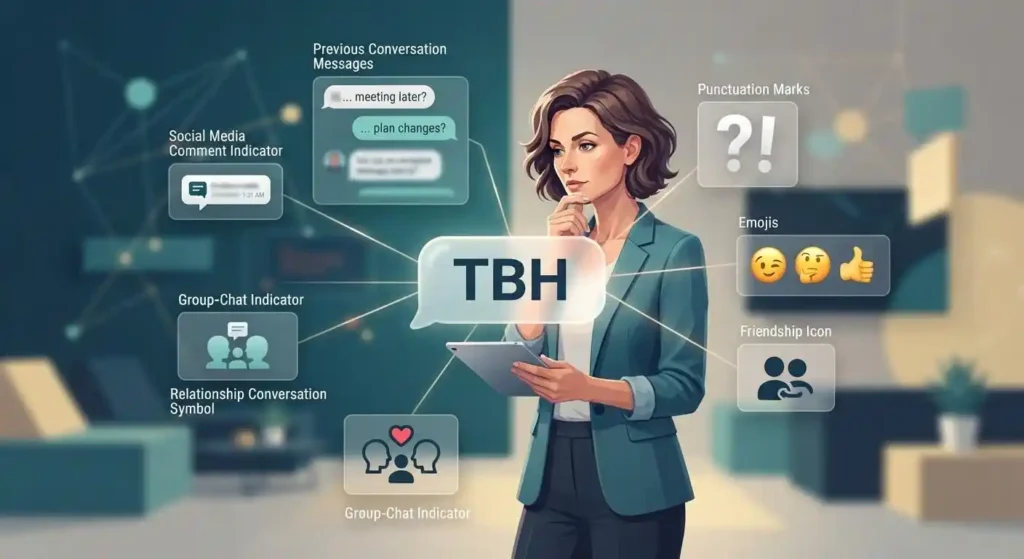
Context is important when interpreting social media slang. The same term may communicate something different depending on the conversation.
From a Friend
A friend might use slang casually without any deeper meaning.
“That movie was fire.”
Here, “fire” can express strong approval.
From a Guy
The meaning does not automatically change because a guy uses a particular slang term. The surrounding conversation matters more than gender.
From a Girl
The same principle applies when a girl uses social media slang. Gender alone does not determine the meaning.
From a Crush
A slang expression from someone you like can feel more significant, but slang by itself does not prove romantic interest.
For example, “you ate” can simply mean the person thinks you did something very well.
In Dating
Social media slang can appear naturally in dating conversations, but the slang itself should not be treated as proof of attraction, flirting, or relationship intent.
In a Relationship
Partners may use casual slang simply because it fits their normal communication style.
In a Group Chat
A term may have a shared meaning within a particular group. The previous messages can help explain what someone intended.
In Social Media Comments
Comments often use short slang expressions to communicate approval, humor, surprise, disagreement, or other reactions.
When a term seems unclear, consider the previous messages, wording, punctuation, emojis, relationship, and conversation topic before deciding what it means.
Real Chat Examples
- “LOL, I can’t believe you actually did that.”
- “TBH, I liked the first movie better.”
- “No cap, that was the best part.”
- “She really ate with that outfit.”
- “I have major FOMO right now.”
- “POV: You forgot your homework again.”
- “IYKYK 😂”
- “SMH, why would he do that?”
- “That player is the GOAT.”
- “This song is fire.”
- “I’m lowkey excited for tomorrow.”
- “That’s actually sus.”
- “Bro, that’s wild.”
- “Big mood.”
- “Facts. I completely agree.”
- “She understood the assignment.”
- “This comment section is sending me.”
- “I’m dead 😂”
- “Okay, that’s a flex.”
- “Spill the tea.”
How to Reply to Social Media Slang
Casual Replies
- “For real.”
- “Same.”
- “Honestly, yeah.”
- “I know, right?”
Friendly Replies
- “Haha, exactly.”
- “Glad you agree.”
- “That’s what I was thinking too.”
- “You get it.”
Funny Replies
- “You really had to say it 😂”
- “Okay, I see you.”
- “That took me out.”
- “Not you saying that.”
Neutral Replies
- “I see what you mean.”
- “That makes sense.”
- “Got it.”
- “Fair enough.”
Flirty/Relationship Replies
When the conversation is already clearly romantic, a response can match that tone:
- “Okay, I see what you’re doing.”
- “You’re making me smile.”
- “That was actually cute.”
- “I’ll take that compliment.”
What Tone Does Social Media Slang Have?
Social media slang is generally:
- Casual
- Informal
- Friendly
- Playful
- Expressive
- Context-dependent
Some terms can also sound sarcastic, teasing, direct, or critical depending on how they are used.
For example, “wow” can express genuine surprise, while “wow…” may communicate disbelief or disappointment. The surrounding conversation helps establish the intended tone.
Is Social Media Slang Rude or Offensive?
Social media slang is not automatically rude or offensive. Most slang is simply informal language used in casual communication.
It is generally more suitable for:
- Friends
- Casual conversations
- Text messages
- DMs
- Group chats
- Social media
- Informal comments
It may be less appropriate for:
- Professional communication
- Formal writing
- Academic work
- Formal workplace messages
Some individual slang terms can be offensive or inappropriate depending on their meaning, so unfamiliar terms should be checked before using them.
Other Meanings of Social Media Slang
Social media slang is a general language category rather than an acronym with separate technology, finance, medical, business, or sports definitions.
However, individual terms within social media slang can have specialized meanings. For example, a term may have one meaning in general conversation and another meaning in gaming or on a particular platform.
Common Mistakes About Social Media Slang
Assuming Every Slang Term Is an Acronym
Not all slang is abbreviated. Terms such as “sus,” “slay,” “salty,” and “flex” are slang expressions rather than traditional acronyms.
Assuming There Is Only One Meaning
Some slang changes meaning depending on context. A word used positively in one conversation may have a different tone elsewhere.
Misreading Context
Looking at a slang term by itself can lead to an incorrect interpretation. The surrounding message often provides important clues.
Assuming Romantic Intent
A slang term used by someone you like does not automatically mean they are flirting or expressing romantic interest.
Confusing Slang With Professional Abbreviations
Some abbreviations appear both online and in professional settings. Their meaning should be determined from context rather than assumed.
Social Media Slang and Related Slang
| Term | Meaning | Common Use |
|---|---|---|
| Internet slang | Informal language used online | Online communication |
| Text slang | Informal language used in texting | Text messages and chats |
| Chat slang | Casual language used in online conversations | Group chats and DMs |
| Texting abbreviation | A shortened form used in messages | Texts and messaging |
| Acronym | A shortened expression formed from letters | Texts, posts, and comments |
| Slang phrase | An informal expression with a particular meaning | Social media and casual conversation |
People Also Ask About Social Media Slang
What is social media slang?
Social media slang is informal language used on social platforms and in online conversations. It includes acronyms, abbreviations, shortened words, phrases, and expressions.
What are examples of social media slang?
Examples include LOL, TBH, FOMO, GOAT, SMH, POV, IYKYK, no cap, sus, slay, and fire. Their meanings depend on how they are used.
Is social media slang the same as internet slang?
The terms overlap, but they are not always identical. Social media slang specifically emphasizes language used on social platforms, while internet slang can include language used across the broader internet.
Are social media slang and abbreviations the same thing?
No. Abbreviations are only one type of social media slang. Social media slang also includes ordinary words and phrases that have developed informal online meanings.
Why does social media slang change?
Online language changes as people create, adapt, and reuse expressions in different communities and contexts. A term can also develop a new meaning when it moves between platforms or groups.
Is social media slang appropriate for school?
It depends on the situation. Casual slang may be fine in informal conversations, but assignments and formal school writing generally call for standard language.
Is social media slang appropriate at work?
It depends on the workplace and the communication channel. Casual internal conversations may allow some informal language, while professional messages and formal documents usually require clearer, more conventional wording.
Can social media slang have different meanings on different platforms?
Yes. A term can develop platform-specific uses or different tones. When a term seems unclear, consider where it appeared and what the surrounding conversation was about.
Conclusion
Social media slang refers to informal words, phrases, abbreviations, acronyms, and expressions used in online communication. It does not have one full form because it describes a broad category rather than a single abbreviation.
It is commonly found in texts, DMs, group chats, posts, comments, and other social media conversations. Its tone is generally casual and informal, but context can make a term friendly, playful, sarcastic, or critical.
The safest way to understand social media slang is to look beyond the individual word. The surrounding conversation, platform, punctuation, emojis, and relationship between the people communicating can all affect the intended meaning.

Amelia Foster is a writer specializing in puns and jokes, creating witty, easy-to-enjoy humor across everyday themes. She covers wordplay inspired by food, Animal, seasons, technology, entertainment, and trending topics. With four years of experience, Amelia researches joke styles, develops and organizes pun concepts, reviews wording, and updates content for clarity and originality.