Instagram and social media slang refers to informal words, abbreviations, acronyms, phrases, and expressions used in posts, comments, DMs, videos, and online conversations. Terms such as POV, DM, FYP, TBH, GOAT, and IYKYK help people communicate ideas, reactions, humor, and tone quickly.
Key Takeaways
- Instagram and social media slang includes abbreviations, internet slang, memes, and platform-specific expressions.
- Some terms have fixed meanings, while others depend heavily on context.
- Slang can appear in captions, comments, Stories, DMs, group chats, and short-form videos.
- The same term may be used across multiple platforms but have different levels of relevance depending on the community.
- Context, emojis, punctuation, and the surrounding conversation can change the tone.
- Social media slang is usually informal and may not be suitable for formal communication.
Instagram & Social Media Slang Meaning
Instagram & social media slang is a broad category rather than one abbreviation with a single full form. It describes the informal language people use to communicate online.
This can include:
- Texting abbreviations
- Chat acronyms
- Internet slang
- Meme phrases
- Social media abbreviations
- Reaction terms
- Platform-specific language
- Messaging shorthand
For example, someone might comment:
“This is so real 😭”
Here, “so real” is not a traditional abbreviation. It is an online expression used to show strong agreement or recognition.
Someone else might write:
“IYKYK.”
That is a social media abbreviation meaning “If You Know, You Know.”
The category is broad because social media language includes both shortened phrases and ordinary words used in newer or context-specific ways.
What Does Instagram & Social Media Slang Stand For?
“Instagram & Social Media Slang” does not stand for anything because it is a category name, not an acronym.
However, many terms within this category do have full forms.
Examples include:
| Slang Term | Meaning |
|---|---|
| DM | Direct Message |
| TBH | To Be Honest |
| POV | Point of View |
| IYKYK | If You Know, You Know |
| FYP | For You Page |
| OOTD | Outfit of the Day |
| GRWM | Get Ready With Me |
| TBT | Throwback Thursday |
| IRL | In Real Life |
| NGL | Not Gonna Lie |
The meaning of each term depends on the abbreviation or expression being used.
How Is Instagram & Social Media Slang Used?
Social media slang is used to save time, create a particular tone, join a trend, react to content, or communicate with people who understand the expression.
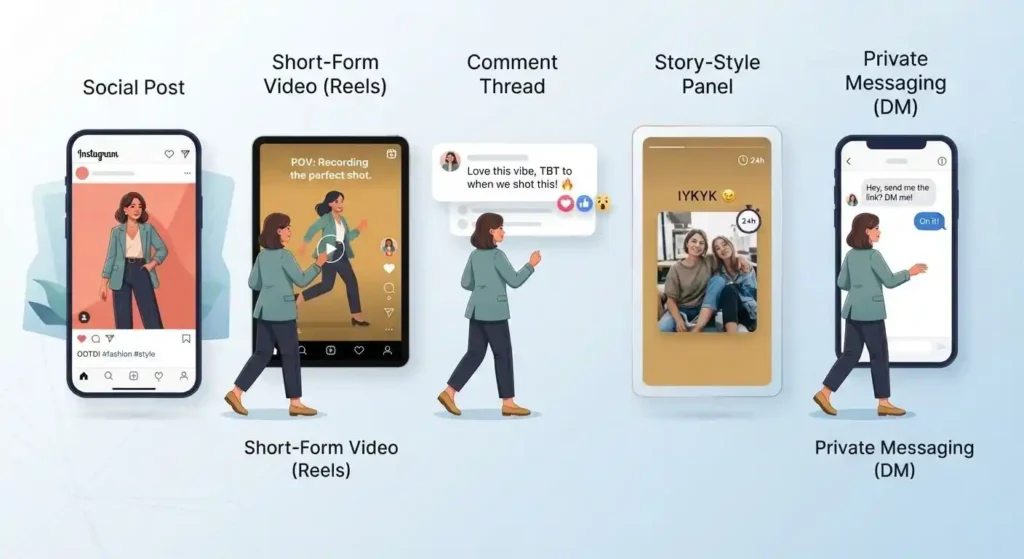
Instagram Slang
On Instagram, slang commonly appears in:
- Captions
- Comments
- Stories
- Reels
- Direct Messages
- Hashtags
Common examples include:
DM — Direct Message
“DM me the details.”
OOTD — Outfit of the Day
“Today’s OOTD.”
TBT — Throwback Thursday
“TBT to last summer.”
IYKYK — If You Know, You Know
“That late-night food spot 😭 IYKYK.”
GRWM — Get Ready With Me
Often used to introduce beauty, fashion, or lifestyle content.
TikTok and Short-Form Video Slang
Some expressions used in short-form video culture also appear widely across Instagram and other platforms.
Examples include:
POV — Point of View
Often used to introduce a scenario or perspective.
“POV: You finally finish all your work.”
FYP — For You Page
Usually refers to the personalized feed associated with TikTok.
Delulu — A playful slang term based on “delusional,” often used jokingly about unrealistic hopes or beliefs.
The tone of terms like these depends heavily on how they are used.
DMs and Online Messaging
Direct messages often use shorter conversational abbreviations.
Examples include:
- IDK = I Don’t Know
- TBH = To Be Honest
- NGL = Not Gonna Lie
- IMO = In My Opinion
- LMK = Let Me Know
- RN = Right Now
- BRB = Be Right Back
These terms function as messaging shorthand and are not limited to one platform.
Comments and Reactions
Comment sections often use slang to express quick reactions.
Examples include:
“No because this is literally me 😭”
“The way I screamed.”
“So real.”
“I’m obsessed.”
“This ate.”
Some expressions are figurative rather than literal. For example, “this ate” is used as praise, meaning the person or content performed exceptionally well or looked especially good.
Common Instagram & Social Media Slang
POV — Point of View
POV introduces a perspective, scenario, or imagined situation.
“POV: Your friend finally replies after three days.”
DM — Direct Message
A private message sent through a social platform.
“DM me when you’re free.”
IYKYK — If You Know, You Know
Used when an experience or reference will only make sense to people who already understand it.
“That one teacher everyone remembers. IYKYK.”
TBH — To Be Honest
Used before giving an opinion or honest statement.
“TBH, I liked the original better.”
NGL — Not Gonna Lie
Similar to “to be honest,” often used before a candid opinion.
“NGL, that was actually good.”
OOTD — Outfit of the Day
Used when sharing a clothing or fashion look.
“Simple OOTD for today.”
GRWM — Get Ready With Me
Usually used for content showing someone preparing for an event or activity.
“GRWM for dinner with friends.”
TBT — Throwback Thursday
Used when sharing an older photo, memory, or video.
“TBT to our beach trip.”
IRL — In Real Life
Used to distinguish offline life from online activity.
“She’s even funnier IRL.”
FYP — For You Page
Refers to a personalized content feed, especially in TikTok-related conversations.
“How did this end up on my FYP?”
GOAT — Greatest of All Time
Used to describe someone or something considered exceptionally good.
“She’s the GOAT.”
ICK — A Sudden Turn-Off
Used to describe something that causes a loss of attraction or interest.
“That gave me the ick.”
The “ick” is subjective. What one person finds unattractive may not bother someone else.
Delulu — Playfully Delusional
Usually used jokingly to describe an unrealistic hope, fantasy, or belief.
“Let me be delulu for a minute.”
The meaning can depend on tone and should not automatically be interpreted as a literal statement about someone’s mental state.
Ate
Used as praise when someone performed, dressed, created, or presented something exceptionally well.
“You ate that look.”
Slay
A compliment meaning someone did something extremely well or looked impressive.
“You absolutely slayed.”
Sus — Suspicious
Used when something or someone seems questionable or suspicious.
“That excuse sounds sus.”
Real Chat Examples
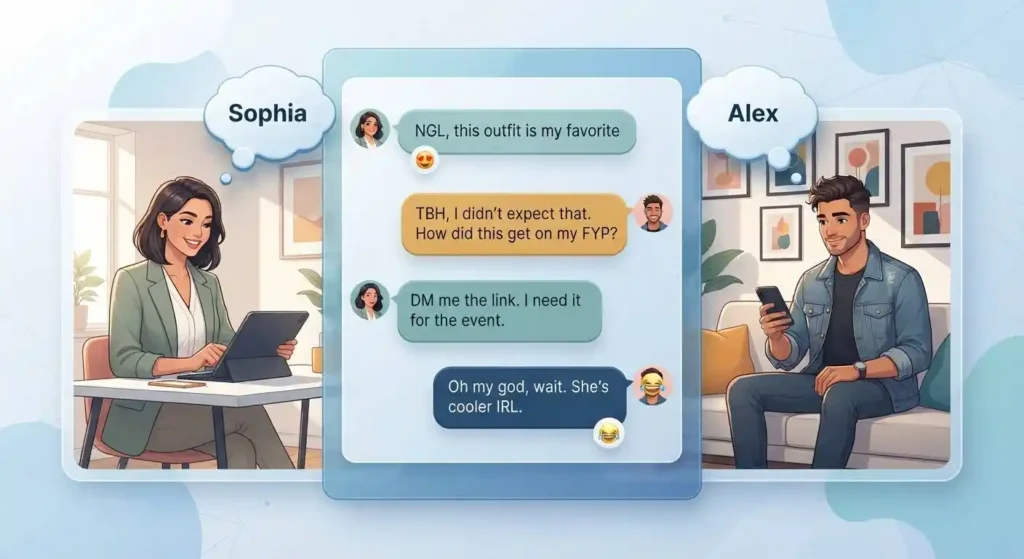
- “DM me the link when you get a chance.”
- “TBH, I didn’t expect that ending.”
- “NGL, this outfit is my favorite.”
- “POV: You remember the assignment is due tonight.”
- “That restaurant 😭 IYKYK.”
- “Your OOTD is so good.”
- “GRWM for my friend’s birthday dinner.”
- “How did this video get on my FYP?”
- “She’s even cooler IRL.”
- “TBT to when we stayed up all night.”
- “This is so real 😭”
- “No because why would I do the exact same thing?”
- “You ate that.”
- “Okayyy, slay.”
- “That was low-key impressive.”
- “That excuse is kinda sus.”
- “NGL, I would be upset too.”
- “That gave me the ick.”
- “I’m delulu, but maybe they’ll text me.”
- “This comment section is sending me.”
- “The GOAT has arrived.”
- “I’m obsessed with this Reel.”
- “Say less, I’m coming.”
- “Bet, see you there.”
- “I can’t 😭”
These examples show why context matters. The same expression can sound enthusiastic, sarcastic, playful, dramatic, or neutral depending on the surrounding message.
How to Reply to Instagram & Social Media Slang
The best reply depends on the specific slang term and the tone of the conversation.
Casual Replies
For everyday slang, you can simply respond naturally.
- “Same.”
- “Honestly, yeah.”
- “I know what you mean.”
- “Exactly.”
- “For real.”
Friendly Replies
- “Haha, that’s so true.”
- “I was thinking the same thing.”
- “You get it.”
- “Okay, now I need the full story.”
Funny Replies
- “Not the FYP exposing me 😭”
- “I fear you might be right.”
- “My delulu era continues.”
- “The algorithm knows too much.”
Neutral Replies
If you do not understand a term:
- “What does that mean?”
- “I haven’t seen that slang before.”
- “Can you explain what you mean?”
- “Is that an Instagram term?”
Flirty or Relationship Replies
Some social media slang may appear in conversations between people who are dating or flirting, but the slang itself does not automatically create romantic meaning.
For example:
“You ate 😍”
can be a compliment, but the sender’s relationship with you, the surrounding conversation, and other wording determine whether it is friendly, playful, or flirtatious.
Context & Relationship Meaning
Instagram and social media slang can appear in messages from a guy, girl, friend, crush, or partner, but gender does not change the dictionary meaning of the term.
What changes is the context.
For example:
“You look good.”
and:
“You ate 😍”
can both be compliments, but emojis and the relationship between the people may affect the tone.
Similarly, phrases such as “I got the ick” or “I’m delulu” should not be overinterpreted without context. A person may be joking, exaggerating, discussing a trend, or expressing a genuine opinion.
The safest interpretation comes from looking at:
- The full conversation
- Previous messages
- Punctuation
- Emojis
- The platform
- The relationship between the people
- Whether the phrase appears to be serious, ironic, or playful
A slang term alone does not prove attraction, rejection, love, jealousy, or romantic interest.
What Tone Does Instagram & Social Media Slang Have?
Social media slang can have many tones.
Depending on the term and context, it may sound:
- Casual
- Friendly
- Playful
- Funny
- Supportive
- Sarcastic
- Dramatic
- Flirty
- Dismissive
For example, “slay” and “you ate” are usually positive forms of praise. “Sus” may express doubt or playful suspicion. “The ick” can communicate dislike or a turn-off.
Tone often changes with punctuation and emojis.
Compare:
“Okay.”
“Okay 😭”
“Okayyy 😂”
The basic response is similar, but the emotional tone changes.
Is Instagram & Social Media Slang Rude or Offensive?
Most social media slang is not automatically rude or offensive. However, some expressions can sound dismissive, insulting, sarcastic, or inappropriate depending on how they are used.
For example, slang involving insults, sexual references, stereotypes, or offensive language may not be suitable for every audience.
In casual conversations, comments, and DMs, informal language is common. In school assignments, professional emails, formal messages, or official documents, full words and clear language are generally safer.
If you are unsure whether someone will understand a slang term, using plain language can prevent confusion.
Who Uses Instagram & Social Media Slang?
Social media slang is used by people across many online communities. Individual terms may become associated with particular platforms, communities, trends, or types of content, but it is not accurate to assume that all social media slang belongs to one generation.
A term can also move from one platform or community into broader online conversations. At the same time, not everyone will recognize every expression.
Understanding the context is usually more useful than trying to identify the age group of the person using it.
Instagram & Social Media Slang and Related Terms
| Term | Meaning | Common Use |
|---|---|---|
| DM | Direct Message | Private messaging |
| POV | Point of View | Scenarios and videos |
| IYKYK | If You Know, You Know | Shared references |
| TBH | To Be Honest | Honest opinions |
| NGL | Not Gonna Lie | Candid reactions |
| OOTD | Outfit of the Day | Fashion posts |
| GRWM | Get Ready With Me | Preparation videos |
| FYP | For You Page | Content discovery |
| IRL | In Real Life | Offline context |
| GOAT | Greatest of All Time | Strong praise |
| ICK | A sudden turn-off | Dating and opinions |
| IMO | In My Opinion | Sharing views |
Common Mistakes About Instagram & Social Media Slang
Assuming Every Term Has Only One Meaning
Some abbreviations have different meanings depending on the platform or conversation. Always check the context before choosing an interpretation.
Taking Slang Literally
Expressions such as “this ate,” “I’m dead,” or “I can’t” are often figurative reactions rather than literal statements.
Assuming Every Term Is New
Social media language includes older internet abbreviations as well as newer expressions. Not every term is tied to a current trend.
Treating Every Compliment as Flirting
A phrase such as “slay” or “you ate” can be friendly praise. The term alone does not reveal romantic intent.
Using Slang in the Wrong Setting
A phrase that works perfectly in a Reel comment may feel confusing or unprofessional in a formal email.
Real-World Conversation
Sam: “Did you see Maya’s new Reel?”
Alex: “Yes 😭 She ate that.”
Sam: “Literally. The outfit, the editing, everything.”
Alex: “I need her to post the details. I’m going to DM her.”
Here, “ate” is praise, while “DM” means sending a private message.
People Also Ask
What is social media slang?
Social media slang is informal language used in online conversations, posts, comments, videos, and messages. It can include abbreviations, acronyms, meme phrases, reaction words, and expressions whose meanings depend on context.
What are common Instagram slang words?
Common examples include DM, POV, OOTD, GRWM, TBT, IYKYK, TBH, NGL, IRL, and GOAT. Instagram users may also use broader internet expressions such as “slay,” “ate,” “sus,” and “the ick.”
What does IYKYK mean on Instagram?
IYKYK means “If You Know, You Know.” It is used when a joke, experience, location, memory, or reference will mainly make sense to people already familiar with it.
What does POV mean on social media?
POV means “Point of View.” On social media, it often introduces a scenario and invites viewers to imagine themselves in a particular situation or perspective.
What does DM mean on Instagram?
DM means “Direct Message.” It refers to a private message sent to another person through the platform rather than a public comment or post.
What does “ate” mean in slang?
“Ate” is often used as praise. Saying someone “ate” or “ate that up” generally means they did something exceptionally well, such as wearing an outfit, giving a performance, or creating content.
What does “the ick” mean on social media?
“The ick” refers to a feeling of sudden dislike or loss of attraction toward someone or something. The reason for the reaction is subjective and can range from a serious concern to a small, humorous annoyance.
Is Instagram slang appropriate for professional communication?
Some common abbreviations may be acceptable in casual workplace chats, but social media slang is usually best avoided in formal or professional communication. Clear, complete language is the safer choice when the audience or setting is formal.
Frequently Asked Questions
How can I understand slang I see on Instagram?
Start by reading the full caption, comment thread, or conversation. Look at the topic, emojis, and surrounding messages, because many slang terms are context-dependent.
Why does social media slang change?
Online language changes as communities create new jokes, phrases, formats, and ways of expressing reactions. Some terms remain useful for years, while others become closely associated with a particular trend or community.
Can the same slang term mean different things?
Yes. Some abbreviations and expressions have multiple meanings, especially when they move between different communities or platforms. Context is the best guide to the intended meaning.
Should I use slang if I do not fully understand it?
It is usually better to understand a term before using it. Slang can sound natural when used correctly but may create confusion when used in the wrong context.
Conclusion
Instagram and social media slang includes the informal abbreviations, acronyms, phrases, and expressions used in online conversations. Terms such as DM, POV, IYKYK, OOTD, GRWM, GOAT, “ate,” and “slay” can help people communicate quickly, react to content, and express tone.
The most important rule is context. Read the surrounding conversation, understand the platform and situation, and avoid assuming that slang automatically signals a particular emotion or romantic meaning.

Emma Brooks is a writer focused on captions and quotes that capture experiences, emotions, and memorable moments. Her four and a half years of work include travel, lifestyle, relationship, event, social media, entertainment, and aesthetic themes. Emma analyzes tone, organizes caption concepts by context, and refines wording to create clear expressions suited to different occasions and visual styles.