Wut in text is an informal, playful spelling of “what.” People use it in chats, texts, comments, and online conversations to show confusion, surprise, disbelief, curiosity, or simply ask what someone means.
Key Takeaways
- Wut means “what” in informal online communication.
- It is a slang spelling, not a traditional acronym with a fixed full form.
- “Wut?” can show confusion, surprise, or a request for clarification.
- “WUT?!” can make the reaction sound more dramatic or surprised.
- The tone can be playful, humorous, confused, or mildly sarcastic depending on context.
- Wut is casual and is generally better suited to informal conversations than school or professional writing.
Wut Meaning in Text
Wut is an informal spelling of the standard English word “what.” It is often used in texting and online communication when someone wants to react quickly or give their message a more playful, expressive feel.
For example:
“Wut?”
Depending on the conversation, this could mean:
- “What?”
- “What do you mean?”
- “Seriously?”
- “I don’t understand.”
- “What just happened?”
The spelling itself does not create a completely different definition. Instead, it gives the ordinary word “what” a more casual or expressive tone.
Wut is also considered a nonstandard internet spelling rather than a formal abbreviation. It can appear as a standalone reaction or inside a sentence, such as “Wut are you talking about?”
What Does Wut Stand For?
Wut does not have a traditional full form like LOL or IDK. It is simply an informal spelling of “what.”
The main meaning is:
Wut = What
The unusual spelling is intentional in most casual online contexts. It can make a message sound less formal and sometimes more humorous or dramatic.
How Is Wut Used?
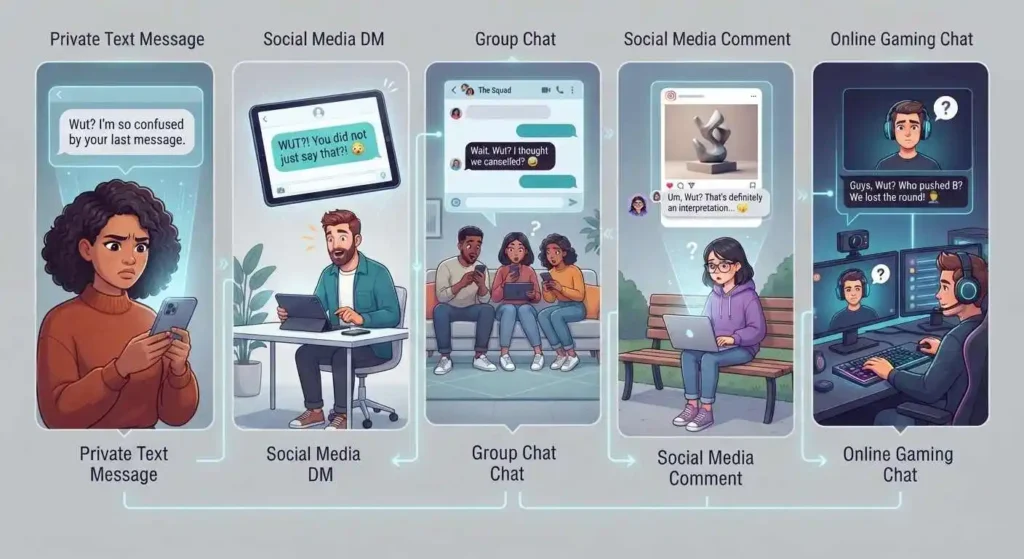
In Text Messages
Someone may type “wut” instead of “what” when reacting to something unexpected.
For example:
“I just ate three pizzas.”
“Wut?”
Here, the response shows surprise or disbelief.
In DMs
Wut can be used as a quick reaction when someone sends an unexpected message.
For example:
“Guess what happened today.”
“Wut?”
The sender is asking the other person to explain.
In Group Chats
Friends may use wut as a playful reaction to something confusing or unusual.
For example:
“Guys, I forgot we had a test today.”
“WUT 😭”
The capitalization and emoji make the reaction more dramatic.
On Social Media
Wut can appear in comments or replies when someone reacts to an unusual post, statement, or video.
For example:
“Wut is happening here 😂”
The word still means “what,” but the spelling gives the comment a casual internet tone.
In Gaming Chats
Wut can also be used during online gaming conversations when something unexpected happens.
For example:
“Wut just happened?”
This is simply an informal version of “What just happened?”
Wut in Different Contexts
The meaning stays close to “what,” but the tone can change depending on the situation.
From a Friend
If a friend replies “wut?”, they may simply be confused or asking you to explain something.
For example:
“You’re not going to believe what happened.”
“Wut?”
This usually means “What happened?”
From Someone You Don’t Know
If a stranger sends “wut?”, it could simply be a request for clarification. It does not automatically mean they are being rude.
From Someone You Like
If someone responds “wut 😂” after your message, they could be surprised or joking around. The word alone does not prove that they are flirting or interested in you.
In Dating Conversations
Wut can appear in casual dating or relationship conversations just as it can in ordinary chats. Its basic meaning remains “what,” although the surrounding messages can make it sound playful, surprised, or confused.
In a Group Chat
A group chat may use “WUT?!” as an exaggerated reaction to something surprising or funny.
In Social Media Comments
A comment such as “wut 😭” may express disbelief, confusion, or amusement depending on the post.
Gender does not automatically change the meaning of wut. Whether it comes from a guy, girl, friend, or crush, the surrounding conversation is more important than the sender’s gender.
Wut vs. What
Wut and what generally communicate the same basic idea, but they do not have exactly the same tone.
| Term | Meaning | Typical Tone |
|---|---|---|
| What? | A standard question or reaction | Neutral |
| Wut? | What? | Casual or playful |
| WUT?! | What?! | Dramatic or surprised |
| Wut lol | What, seriously? | Amused or playful |
| Wuttt? | What?! | Exaggerated or surprised |
For example:
“What happened?”
sounds neutral.
“Wut happened?”
sounds more casual and informal.
“WUT happened?!”
sounds much more surprised or dramatic.
Real Chat Examples
- Person A: “I just won a free trip.”
Person B: “Wut?!” - Person A: “I forgot my backpack at home.”
Person B: “Wut 😂” - Person A: “Guess what?”
Person B: “Wut?” - Person A: “The teacher canceled the test.”
Person B: “WUT?!” - Person A: “I’m moving next month.”
Person B: “Wut? Seriously?” - Person A: “My dog learned how to open the door.”
Person B: “Wut 😭” - Person A: “I finished the whole project already.”
Person B: “Wut? How?” - Person A: “I saw your favorite actor today.”
Person B: “Wut?! Where?” - Person A: “We don’t have school tomorrow.”
Person B: “WUT?” - Person A: “I accidentally sent it to the wrong group chat.”
Person B: “Wut 💀” - Person A: “What are you doing?”
Person B: “Wut do you mean?” - Person A: “I can’t find my phone.”
Person B: “Wut? You were just holding it.” - Person A: “That movie has a surprise ending.”
Person B: “Wut? Don’t spoil it.” - Person A: “I changed my username.”
Person B: “Wut? Why?” - Person A: “We’re meeting at 6 instead.”
Person B: “Wut? I thought it was 7.” - Person A: “I got the highest score.”
Person B: “Wut?! Nice!” - Person A: “I forgot what I was going to say.”
Person B: “Wut 😂” - Person A: “Look at this picture.”
Person B: “Wut is that?” - Person A: “He actually said that.”
Person B: “Wut?” - Person A: “I accidentally wore two different shoes.”
Person B: “WUT 😭”
How to Reply to Wut
Your reply depends on why the person said “wut.”
Casual Replies
If they seem confused:
- “I mean…”
- “Let me explain.”
- “You heard me 😂”
- “Yeah, seriously.”
Friendly Replies
If they are asking for clarification:
- “I’ll tell you what happened.”
- “Okay, so basically…”
- “Long story 😂”
- “You won’t believe it.”
Funny Replies
If the conversation is playful:
- “You read that right 😂”
- “I said what I said.”
- “Don’t ask questions 😂”
- “Exactly what it sounds like.”
Neutral Replies
If you are not sure why they said it:
- “What part confused you?”
- “What do you mean?”
- “Want me to explain?”
Flirty or Relationship Replies
If the conversation already has a playful tone, you could respond with something light such as:
- “You heard me 😏”
- “Why are you surprised?”
- “I knew you’d react like that 😂”
The word wut itself does not establish romantic interest, so the rest of the conversation matters.
What Tone Does Wut Have?
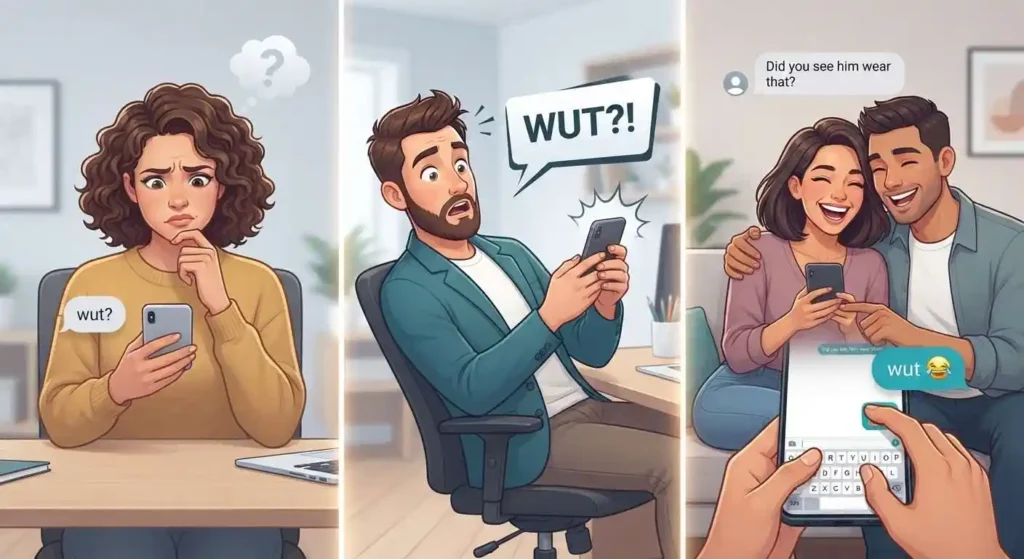
Wut is generally informal and can have several tones.
Casual
It can simply replace “what” in a relaxed conversation.
Playful
Friends may use it to make a reaction sound funny or exaggerated.
Surprised
“WUT?!” can communicate strong surprise.
Confused
“Wut?” can mean “I don’t understand.”
Disbelieving
Someone may use “wut?” when they find a statement difficult to believe.
Sarcastic
In some conversations, wut can be used sarcastically, especially when the sender is reacting to something obviously strange or ridiculous.
The exact tone depends on the surrounding message, punctuation, capitalization, emojis, and relationship between the people.
Is Wut Rude or Offensive?
Wut is not inherently rude or offensive. It is simply an informal spelling of “what.”
However, a one-word response such as “wut?” can sometimes sound dismissive or sarcastic if the conversation is serious.
For example:
“I need to talk to you about something important.”
“Wut?”
could sound less considerate than:
“What is it?”
For casual conversations, texts, DMs, gaming chats, and social-media comments, wut can be fine. For school assignments, professional emails, formal writing, or workplace communication, “what” is the better choice.
Other Meanings of Wut
Wut in Internet Slang
The main slang meaning of wut is “what.” It is used as an informal or playful spelling, especially as a reaction to something unexpected.
WUT as an Acronym
Uppercase WUT can refer to unrelated names or organizations in specialized contexts. For example, WUT can be used as an abbreviation for universities and other proper names.
These meanings are separate from the everyday texting slang “wut,” so the context is important.
Common Mistakes About Wut
Thinking Wut Is Always a Typo
In online conversations, wut is often intentionally written that way. It can be used to create a casual, humorous, or surprised tone.
Thinking Wut Has a Special Full Form
Wut is not normally an acronym. It is simply an informal spelling of “what.”
Assuming Wut Always Means Anger
A message such as “wut?” can show confusion, surprise, humor, or disbelief. It does not automatically mean the sender is angry.
Assuming Wut Is Always Sarcastic
Sarcasm is possible, but it depends on the conversation. You should not assume sarcasm from the spelling alone.
Assuming It Shows Romantic Interest
If someone you like says “wut?”, it generally means “what?” The word itself does not reveal whether they are interested romantically.
Wut and Related Slang
| Term | Meaning | Common Use |
|---|---|---|
| Wut | What | Casual reaction or question |
| Wat | What | Informal internet spelling |
| Wuttt | What?! | Exaggerated reaction |
| WTF | What the fuck | Strong surprise, confusion, or disbelief |
| WTH | What the heck / what the hell | Surprise or confusion |
| WYD | What you doing? | Asking what someone is doing |
| WYA | Where you at? | Asking where someone is |
| WBU | What about you? | Returning a question |
Wut is less like a traditional acronym and more like an intentionally altered spelling of an ordinary word.
People Also Ask About Wut Meaning in Text
Is wut short for what?
Yes. In texting and internet slang, wut is an informal spelling of “what.” It does not normally represent a separate phrase or traditional acronym.
What does wut mean from a girl?
If a girl texts “wut,” it generally means “what.” The sender’s gender does not change the basic meaning, although the tone can depend on the conversation.
What does wut mean from a guy?
A guy using “wut” is generally writing an informal version of “what.” It may show confusion, surprise, disbelief, or a request for clarification.
Is wut a bad word?
No. Wut itself is not a bad word. It is an informal spelling of “what,” although it may sound too casual for formal situations.
Why do people type wut instead of what?
People may use wut because it feels more casual, playful, humorous, or expressive. It can also make a reaction seem more exaggerated than the standard spelling “what.”
What does “WUT?!” mean?
“WUT?!” usually means something like “What?!” or “Are you serious?!” The combination of uppercase letters and punctuation often makes the reaction sound more dramatic or surprised.
Is wut an acronym?
No. In normal texting, wut is not an acronym. It is an informal spelling of “what.”
Can wut sound rude?
It can, depending on the situation. A short “wut?” during a serious conversation might sound dismissive, while the same word between friends may simply be playful.
Conclusion
Wut meaning in text is simple: it is an informal spelling of “what.” People use it in texts, DMs, group chats, gaming conversations, social media, and other casual online communication.
Depending on the context, wut can express confusion, surprise, disbelief, curiosity, humor, or a request for clarification. Capitalization, punctuation, emojis, and the surrounding conversation can change how it feels.
Wut is not normally an acronym and does not have a traditional full form. It is casual internet slang, so “what” is the better choice for school, work, professional communication, and formal writing.

Emma Brooks is a writer focused on captions and quotes that capture experiences, emotions, and memorable moments. Her four and a half years of work include travel, lifestyle, relationship, event, social media, entertainment, and aesthetic themes. Emma analyzes tone, organizes caption concepts by context, and refines wording to create clear expressions suited to different occasions and visual styles.